
Fix your cup
WHY IS YOUR
MATCHA BITTER?
Before buying another tin, make one cup where you know the numbers.

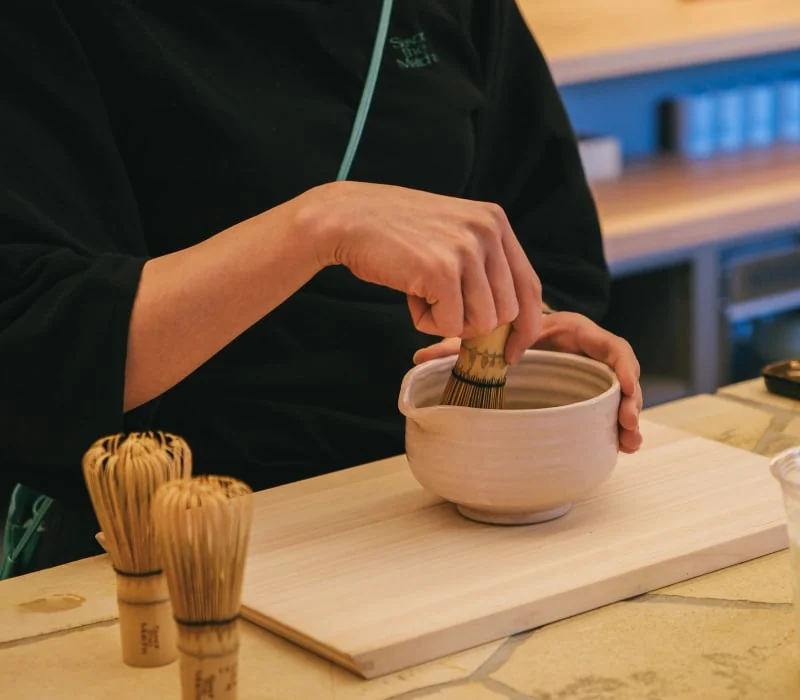
Keep the powder and milk the same. Measure the water. Then change one thing.
That gives you a chance of working out whether you dislike the tea, the recipe, or a mouthful of powder that never mixed properly.
There isn’t one setting that makes every matcha taste good. But there is a much better test than adding random amounts until the glass is full.
Is it bitter, dry or just lumpy?
Those are useful distinctions. A strong tea taste, a drying sensation and a clump of unmixed powder are different things to troubleshoot.
Ippodo’s tea FAQ explains that some bitterness and astringency are natural in Japanese tea. Its own recipes reflect the tea house’s preferences. It also suggests using less tea or lower-temperature water when the brew feels too strong.
So ‘real matcha is never bitter’ is a poor buying rule. Your aim is a cup you enjoy, with enough information to make it again.
Weigh the powder once.
A flat teaspoon and a heaped teaspoon can put different amounts into the bowl. A small scale makes the comparison easier.
For a reference point, Ippodo’s published preparation for its Organic Matcha uses 2g of sifted powder and 60ml of water at 80°C. That’s a recipe for that pure tea, not a universal serving size for every latte powder.
Follow your own pack first. If you’re using a sweetened blend, the grams may represent tea plus other ingredients. Two grams of a blend is not automatically the same amount of tea as two grams of pure matcha.
Try a cooler cup before adding more sweetness.
If you’ve been pouring straight from a boiling kettle, try the temperature suggested on your tea’s pack. For a controlled comparison with pure matcha, you could make two small cups at 80°C and 70°C, keeping the powder and water amounts the same.
That is a taste comparison, not a promise that 70°C fixes every tea. Write down which cup you prefer. If neither works for you, you’ve still learnt something useful about that powder and recipe.
You don’t need to chase a perfect foam while the basic flavour is wrong for you.
Get the powder mixed before the milk.
Sift the powder if it has clumped, add your measured water and whisk before pouring it into the milk. Ippodo includes sifting in its preparation steps.
If you change your whisking method, keep the amounts fixed for that test. A new whisk, a bigger scoop and less milk all at once leave you guessing about which change helped.
For an iced latte, try the finished drink after stirring too. A beautiful green layer on top isn’t the same as an evenly mixed cup.
Your milk is part of the recipe.
Milk changes the balance of the drink. Measure it instead of filling whichever glass is clean. Keep the brand and type of milk the same while you compare powders.
Our iced matcha recipe calculator starts with 2g of pure matcha, 60ml of warm water and 150ml of milk for one iced latte. It is a starting recipe you can adjust, not a direction for every blend.
If the tea disappears under the milk, that is a different problem from a harsh cup. Record both: can you taste the matcha, and do you enjoy what you taste?
Keep the version you can repeat.
Write down the powder, grams, water amount, temperature and milk. Add one plain note about the result. ‘Too dry at the end’ is more useful than ‘bad’.
Then make your favourite version again. For a café, have someone else follow the same recipe. A cup that only works when one person improvises is difficult to put on a menu.
You can use our café tasting sheet to keep the comparison together. At home, saving the recipe in the cup builder is enough. A better cup doesn’t need a more complicated routine.
Sources & notes.
Sources checked 23 October 2026.
MAKE YOUR NEXT CUP.
Measure it. Adjust it. Save the one you like.